Krantz’s cursed marriage oath to Christina
The Best Werewolf Short Stories 1800-1849Krantz’s cursed marriage oath to Christina is the improvised supernatural ceremony by which Krantz accepts Christina as his wife under the authority of her father, Wilfred of Barnsdorf. It is decisive because the vow does more than formalize a second marriage: by invoking the spirits of the Hartz Mountains and attaching explicit vengeance to any breach, it places Krantz’s domestic future under a curse that reaches beyond the couple to their children.
Circumstances and Participants
The oath takes place after Wilfred of Barnsdorf and Christina have lived for about three weeks at Krantz’s cottage. Wilfred and Krantz go hunting daily, while Christina performs the household duties and gradually wins the affection even of little Marcella. At the same time, Krantz undergoes a marked change: he appears to overcome his former aversion to women, becomes attentive to Christina, and often remains awake with her beside the fire after the children have gone to bed. The marriage therefore emerges from an established household arrangement rather than from a sudden encounter.
A consultation is held after the children have been sent to bed. Krantz has asked Christina to marry him and has obtained both her consent and Wilfred’s. The absence of a priest and of ordinary legal authority creates the immediate problem. Wilfred does not reject the match; instead, he insists that some ceremony must satisfy a father in the wilderness. He offers to marry them according to his own fashion, and Krantz impatiently agrees.
The Ceremony and Vow
Wilfred begins by requiring Krantz to take Christina by the hand and swear. The form resembles a marriage promise, but its language is markedly more dangerous than a conventional Christian formula. Krantz pledges that Christina is his wedded wife, that he will protect, cherish, and love her, and that his hand will never be raised against her. The promise defines marriage as both affection and an absolute prohibition against violence.
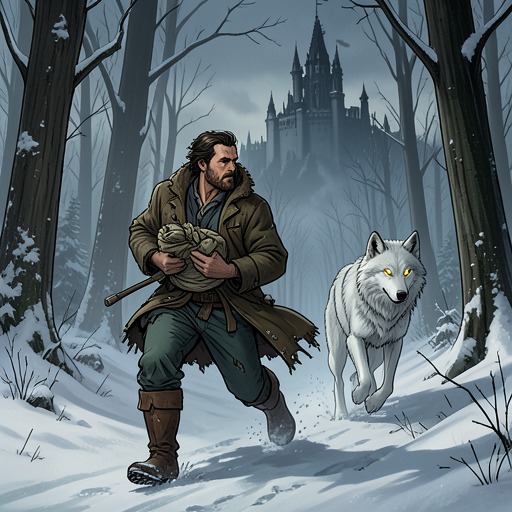
The oath’s force comes from its supernatural witness. Krantz swears by all the spirits of the Hartz Mountains and by their power for good or evil. Wilfred then adds the penalty clause: if Krantz fails in his vow, the vengeance of those spirits is to fall upon him and his children. The threatened fate is expressed through predation and bodily dismemberment: the family may perish by the vulture, the wolf, or other beasts of the forest, with their flesh torn from their limbs and their bones left to blanch in the wilderness.
Krantz repeats Wilfred’s words, making the curse binding through his own speech. His hesitation at the final sentence exposes the gravity of what he is accepting. Little Marcella bursts into tears while the last words are repeated, and the interruption unsettles the adults. Krantz responds harshly to the child, who hides her face beneath the bedclothes and suppresses her sobs. The scene thus places a child’s instinctive distress beside the adults’ attempt to treat the oath as a marriage rite.
Immediate Consequences
The ceremony is described as Krantz’s second marriage. Its improvised character separates it from ordinary social and ecclesiastical order: there is no priest, no stated legal bond, and no public community to ratify it. Wilfred’s authority as father supplies the ceremony, while the spirits of the Hartz Mountains supply its supernatural sanction. Marriage becomes a threshold between domestic belonging and exposure to forces outside human law.
The next morning Wilfred mounts his horse and rides away, leaving Christina with Krantz and the children. His departure removes the oath’s human witness from the cottage while leaving its terms in force. Christina remains in the household under a vow whose obligations and punishments Krantz has accepted, and the family is left to live under the threat that any failure of the promise may be visited upon the next generation.
Narrative Function and Foreshadowing
The oath is recalled in an embedded account told by Cæsar, so the reader receives it as part of a history being reconstructed after the family’s earlier experiences. Its position within that recollection gives the ceremony the quality of a disclosed origin: what first appears to be an unusual wedding is also the creation of the curse that governs later events. The explicit mention of wolves, torn flesh, and bones whitening in the wilderness makes the future danger legible before its fulfillment.
The vow also joins several recurrent boundaries in the narrative. It is spoken in a remote cottage rather than a church, at night after the household has withdrawn, and under the authority of mountain spirits rather than public religion. The wider story repeatedly places supernatural danger beside formal rites, from All Souls’ Eve, the haunted night before All Souls’ Day, to public religious and judicial ceremonies. Against that background, Krantz’s oath is a private counter-ritual: intimate in its subject, but expansive in its consequences.
Its central dramatic conflict is the collision between a promise of protection and the possibility of violence. Krantz swears that his hand will never harm Christina, yet the penalty is imagined in the language of bodily attack. The oath therefore establishes marriage as both shelter and trap. It promises care while preparing a structure in which betrayal, punishment, and inherited suffering become inseparable from the family bond.
Place in the Tragic Pattern
The ceremony carries the logic of a curse rather than the reassurance of a happy ending. Krantz’s hesitation, Marcella’s tears, and Wilfred’s departure interrupt any sense that the marriage has restored stable domestic order. The oath binds the adults, alarms the child, and converts an apparently private decision into a threat against descendants. Its significance lies not only in what Krantz promises, but in the terms under which the promise is made: the Hartz spirits are called as witnesses, and the wilderness is named as the place where the family’s remains may ultimately be exposed.